
Keeping up with the current research can become a full-time job with less pay and glory. And most tasks that it involves take precious time: Running searches, scanning trial registries, organising what’s relevant and what’s not.
And after all this time, it may amount to nothing. No insights, no improvements to current practice, and no new hope for patients.
Why this saves time differently from a generic AI tool
Our goal is quality. Generative AI is only as good as the input it receives, otherwise it hallucinates and misses important information.
That’s why we scan only the most reputable sources. Also, our system is self-contained (we don’t depend on Anthropic or OpenAI) and is under constant human review. The MS research page is curated manually to make sure we do not miss papers with mentions of myelin repair or brain-penetrant anti-inflammatories.
We are working towards expanding this human review to other research areas and conditions.
The search queries are validated by the scientists doing the work — REGENERAR at Coimbra for cell reprogramming, LPJ Lab at Cambridge for neuroimmunometabolism, iMed.ULisboa for neuroinflammation.
Our methodology, the data, and the code are open — you can audit anything, including how we tag categories. Third, the engine is the same GregoryAI that has been running Gregory-MS since 2021, with 42,000+ articles indexed and 4,400+ flagged as relevant for MS alone.
One feed, all the registries
From PubMed to bioRxiv, we harvest several different sources to stay up to date with research. Clinical Trials are also tracked from the International Clinical Trial Registry Platform (ICTRP), European Clinical Trial Registry, and ClinicalTrialsGov.
Our system removes duplicates, fills in missing data from CrossRef, and runs Machine Learning (ML) algorithms to surface research with positive patient outcomes. This happens daily.
We then present them as a single feed per research area and condition.
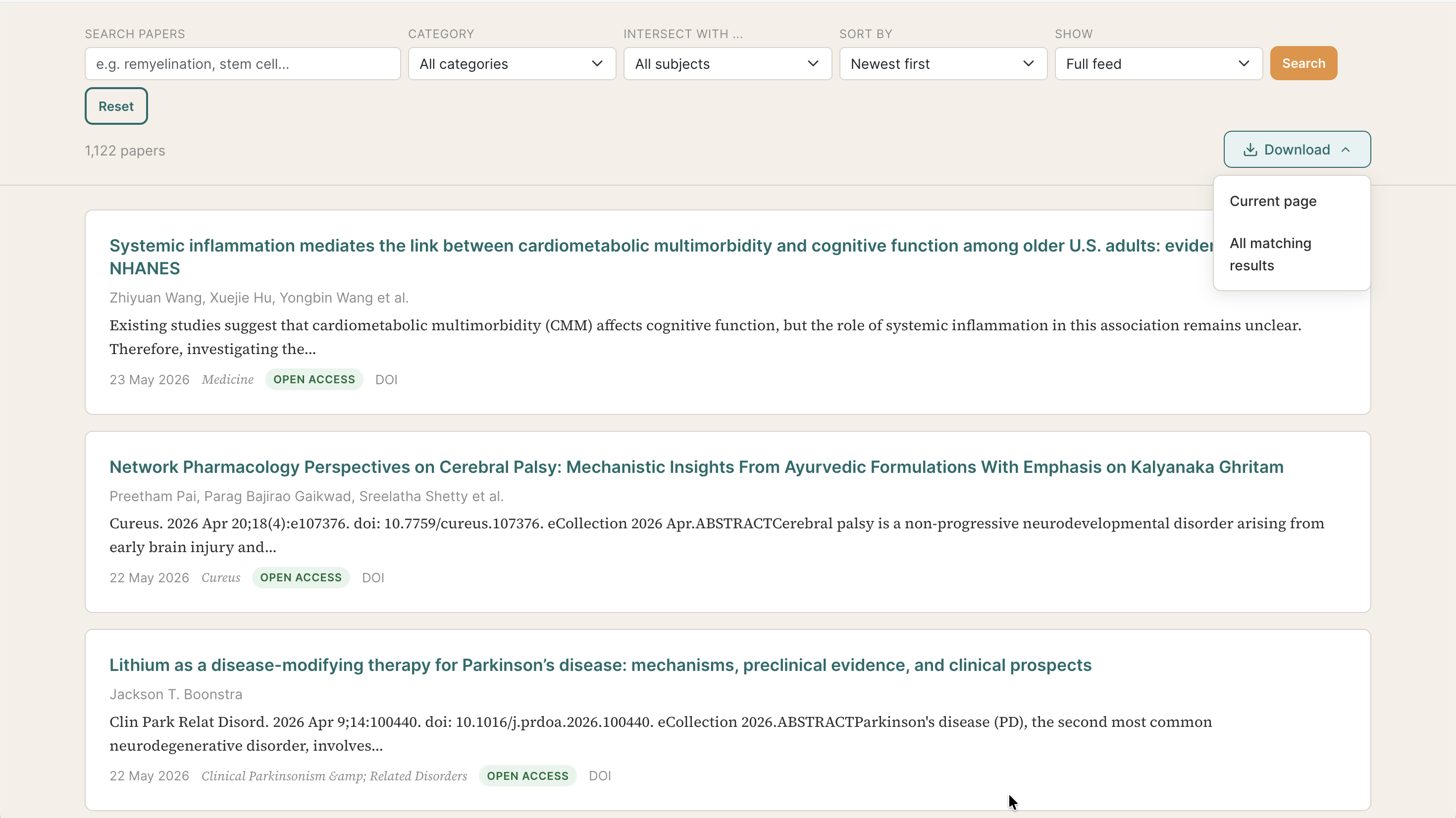
Search queries you can read
Each research area page lists the exact PubMed-style queries our scientific curators use to populate the feed — under “Search methodology”. You can see why a paper showed up, copy a query into your own workflow, or flag one that needs widening.
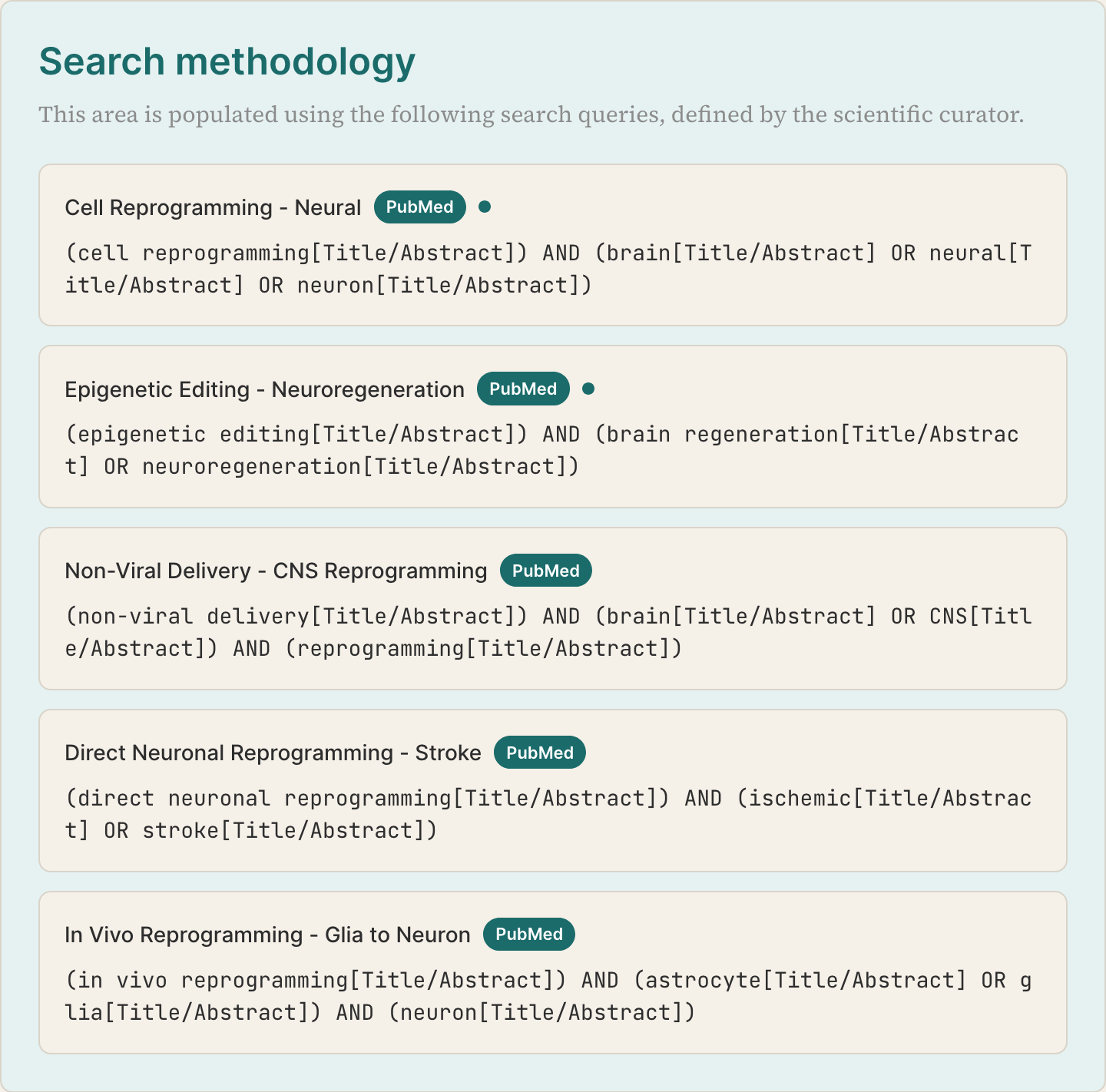
AI relevance to surface promising research
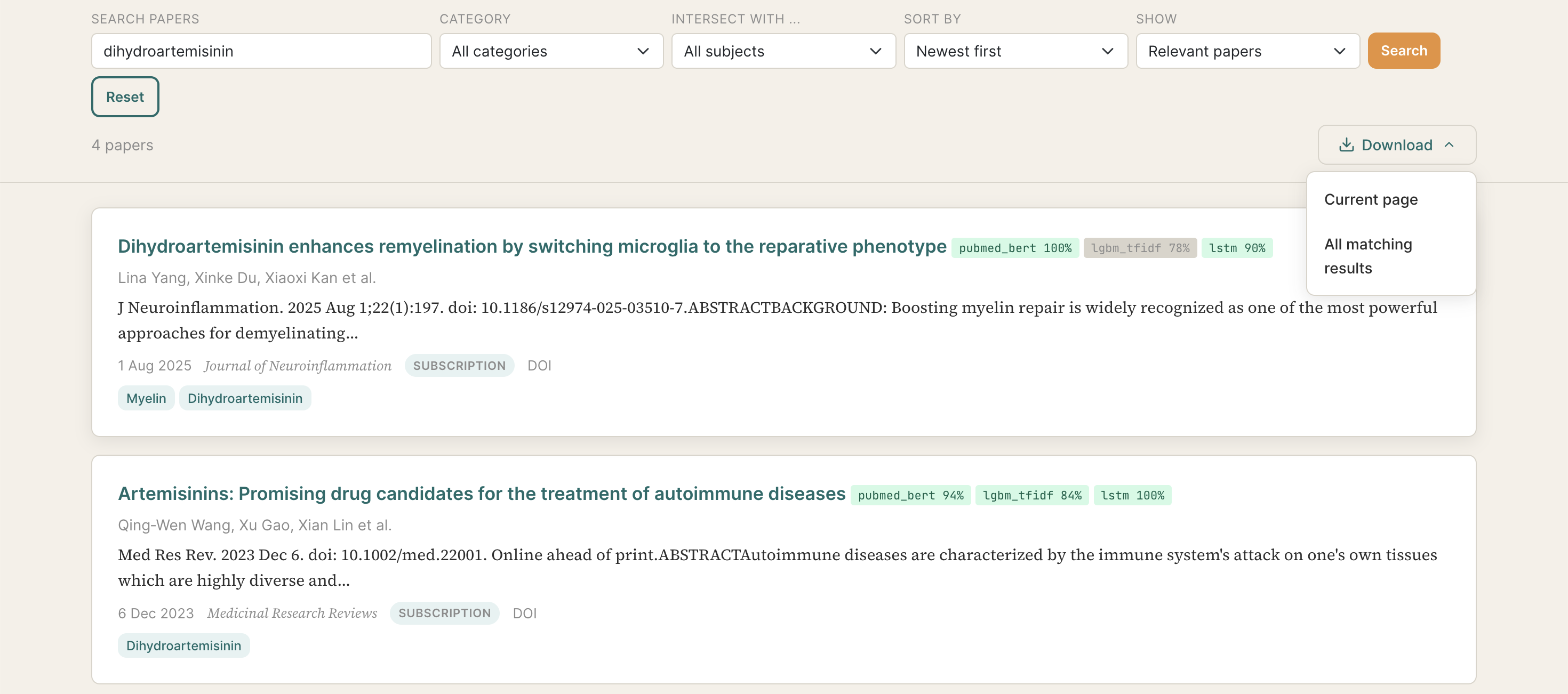
We use GregoryAI to score every paper for relevance using independent machine-learning models, displayed on each article (we show the algorithm, the percentage, and the threshold). On any feed you can switch between “Relevant papers” and “Full feed”, or sort by AI relevance instead of date. The triage your eyes used to do — done before you arrive.
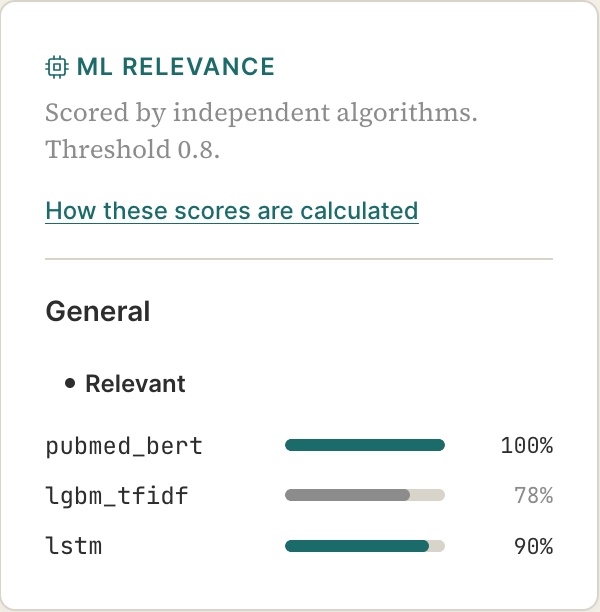
There is also an option to download the listing to a CSV1 file.
Linked clinical trials
When an article mentions an NCT number or equivalent identifier, we extract it and link the trial directly from the article page. If you are mapping a therapeutic area, the citation-to-trial step is done.
Filter, search, and export
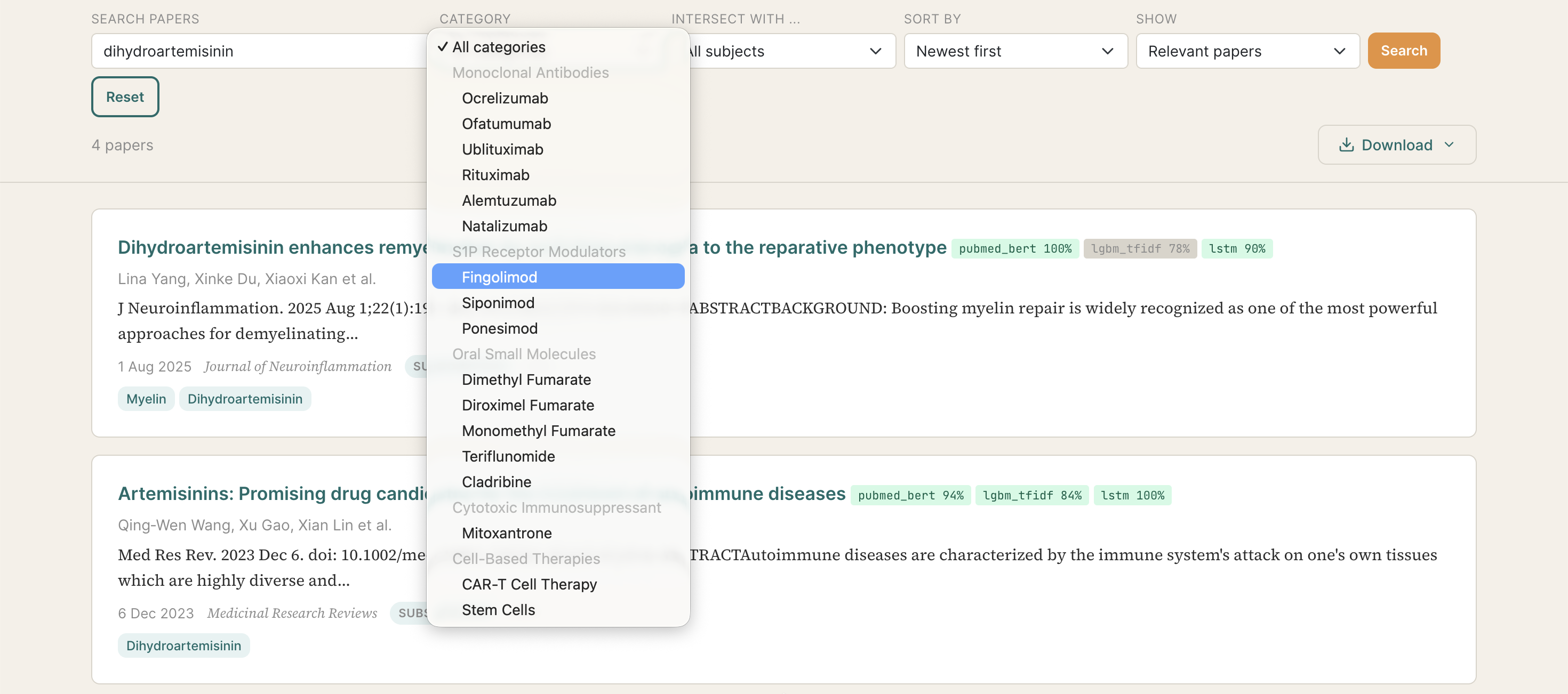
The research feed has a filter bar with keyword search, category filters (for example, by drug or treatment type — Ocrelizumab, Cladribine, Stem Cells, CAR-T — on the MS papers page), and date or relevance sorting. When you find a slice you want to keep, the Download button exports either the current page or every matching result as CSV. Drop it into Zotero, EndNote, or a spreadsheet.
A weekly digest you can trust
Every research area and condition page has a one-click subscription to a weekly digest. These emails include the most relevant papers discovered, and the recent clinical trials registered.
Save time finding clinical trials
Our clinical trial alerts fire every six hours to make sure you, and your patients, don’t miss the chance to participate.
Try it on your own area
Pick one — cell reprogramming, neuroinflammation, or neuroimmunometabolism — and run a search you would normally run in PubMed. If the curated query is too narrow or too broad for what you do, tell us. The point of building in the open is that the observatory gets sharper when researchers push back.
And if you lead a group working on a brain regeneration topic we do not yet cover, we are looking for scientific curators to expand the observatory. Your queries, our infrastructure, your community’s time saved.
-
CSV (Comma-Separated Values) is a plain-text format where each row is a line and columns are separated by commas. CSV files can be opened in spreadsheet apps like Excel or Google Sheets, or processed programmatically. ↩︎